
Reclaim Site Visit – Tour Summary (By Jeff He)
I visited Reclaim’s Auckland site around lunchtime and joined a group of around 18 people for a guided tour led by Bruce. The tour gave a practical, behind-the-scenes look at how recycling actually works in New Zealand, and how much of it still depends on manual effort and correct sorting.
Walking Through the Site
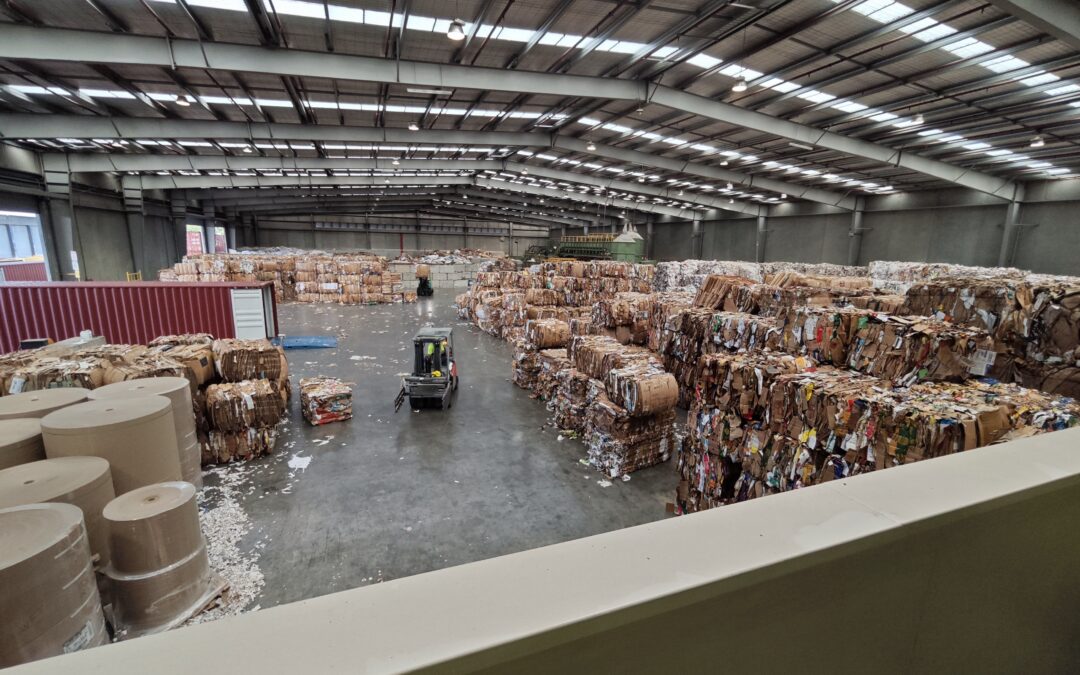
We started at the public drop-off cages before moving into the indoor paper recycling warehouse. Inside, large volumes of paper were being manually sorted into different piles. This is because not all paper is the same—different types contain different fibres, and the value comes from the quality of those fibres. Locally produced NZ paper tends to be more valuable due to stronger fibres from sustainably grown trees.
After sorting, the paper is compacted into large cubes and loaded into containers for export. An interesting constraint is transport limits—some countries only allow containers up to around 30 tonnes on the road, so loads must be carefully balanced. If overweight, material has to be removed and reloaded.
I also learned that even something like A4 paper packaging can contain plastic to control moisture levels. Paper performs best at around 8% moisture—too dry and it becomes brittle, too wet and it won’t run properly through printers.
One of the highest-quality materials on site was clean paper offcuts from printing companies—these are untouched, uniform, and highly recyclable.
We also saw compacted cubes of aluminium cans ready for export, and the massive green compactor machine, roughly two stories high.
Document Shredding
The next stop was the secure document shredding facility. Paper from secure bins across Auckland is processed here, but even at this stage, manual sorting is required to remove non-recyclable materials before shredding.
Plastic Recycling
In the plastic recycling area, we saw large volumes of bottles. In NZ, only plastics marked 1, 2, and 5 are generally accepted. Bottle caps should always be removed, as they interfere with the compaction process (they can be recycled separately through supermarket schemes).
We then moved to the soft plastics warehouse, where there were mountains of plastic wrapping. Only certain types—such as clean LDPE film—can be recycled. Many soft plastics are printed or contaminated, making them difficult or uneconomic to process.
Yard and Operations
In the vehicle and bin yard, we saw how Reclaim maximises reuse. For example, if a truck breaks down, the bin can be removed, serviced, and placed onto another working truck. The focus is on reusing as much as possible.
Key Learnings
A big takeaway is how important it is to clean recyclables. Items like pizza boxes, milk bottles, and butter containers can all be recycled, but only if food residue is removed. Contamination is one of the main reasons materials end up in landfill instead of being recycled.
The tour also highlighted the environmental impact of waste—plastics break down into microplastics, which enter the food chain (e.g. fish), and ultimately humans.
Beyond NZ – Energy from Waste
As an interesting comparison, countries like China are investing heavily in waste-to-energy systems, where rubbish is incinerated to generate electricity at large scale, reducing landfill use.
In New Zealand, a different approach is emerging—food scraps are being processed through anaerobic digestion to produce biogas, which can be used to generate electricity and heat. This shows how waste can become a resource when managed correctly.
Overall Reflection
The visit made it clear that recycling is not a simple or fully automated process. It relies heavily on correct sorting, clean materials, and economic viability. In a small country like NZ, scale is a major limitation, meaning a lot of materials are still exported. Ultimately, individual behaviour—what we throw away and how we prepare it—has a significant impact on how effective the system is.
Recent Comments